10 facts about Conifers!
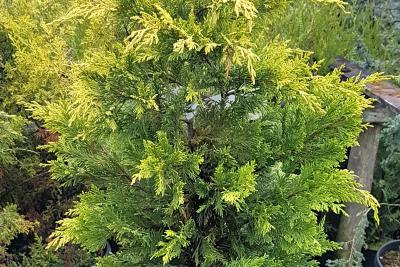
Conifers come in a variety of colours, not just green: they can be red, bronze, yellow or even blue.
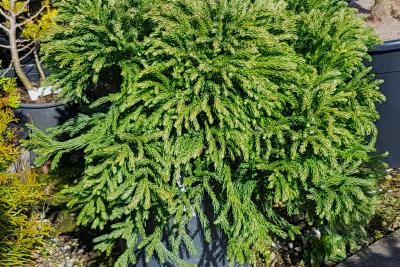
The colour of a Conifer can be influenced by the temperature of its habitat, for example, the Thuja 'Rheingold' is a yellowy-red in the summer and turns to bronze in the winter while the Cryptomeria japonica 'Elegans' is a greeny-red in the summer and turns to a bronzy-red in the winter.
Conifers come in all different sizes, from the 30 centimetre Juniperus communis 'Compacta' which is small in comparison to the 125 metre Redwoods which give us the tallest and largest trees in the world and can be found growing in California.
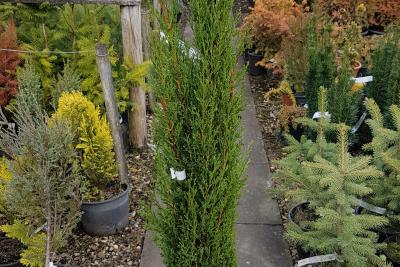
Conifers can be many different shapes for example, flat and hugging the ground (Juniperis horizontalis), arrow-shaped (Taxodium or the Swamp cypress), tiered (Cedar) and globe shaped (Thuja occidentalis 'Globose).
Most Conifers are evergreen, but what many people don't know is that there are 5 genus which are deciduous: they are the Larix, Pseudolarix, Metasequoia, Taxodium, and the Glyptostrobus.
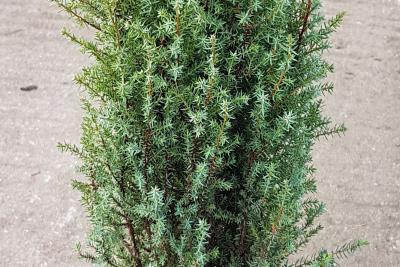
Conifers have 2 different types of leaves, needles and scales, but the Juniperus can have both juvenile and adult foliage depending on its age (it can change from needles to scales over time).
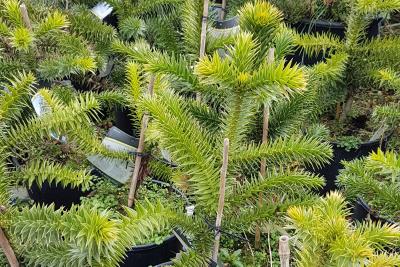
Conifers grow in either temperate or tropical climates: however the Araucaria genus (Monkey Puzzle Tree) can be found in both temperate and tropical climates.
Conifers are usually found in either the Northern or the Southern hemisphere, for example, Pinus sylvestris grows in the Northern hemisphere and the Agathis australis grows in the Southern hemisphere.
Conifers can be found growing at any height from sea level right up to alpine conditions for example the Pinus mugo grow on the mountains of Central Europe.
The Pinus aristata (longeava) is found in the white and Rocky Mountain ranges in the USA and has been carbon ring-dated as the oldest living tree in the world.
Planting your Conifers
Conifers will tolerate most soils, but avoid planting in areas that waterlog regularly, except Taxodium distichum (swamp cypress) and Metasequola (dawn redwood), A very chalky soil will suit Taxus (yew), some junipers and pines. Local climate, such as areas of high or low rainfall, can affect height and spread. To help you choose the right conifer for your garden, take a browse through our range below.
Before planting, remove the tree from the pot and soak the rootball in a bucket of water for about 10 minutes. Clear the planting area of any weeds. Make the planting hole about twice the size of the rootball: the top of the rootball should be just 2.5cm below ground level.
Refill the planting hole with soil mixed with peat coir or very well rotted compost. Do not use nitrogenous fertilisers such as poultry or horse manure or bedding plant compost as this usually contains fast release fertiliser, which can damage conifer roots. One or two feeds with a slow release fertiliser will be quite enough to maintain growth. Give enough water to keep the rootball moist but not waterlogged in the early years after planting.

Stone Pine. A spreading conifer with twisted glossy green needle-like leaves. Produces brown cones. Height 15-20m. Spread 6-9m. Evergreen. A slow growing pine that can be used to block overlooking windows or unsightly views. Ideal for creating an Italian feel to a space.
Eastern White Pine. A slender conical conifer becoming columnar with grey-green needle-like leaves. Produces green cones ripening brown. Height 35m. Spread 6-8m. Evergreen. Hardy.
Eastern White Pine. A dwarf dense conifer becoming wider than it is high with grey-green needle-like leaves. Produces green cones ripening brown. Height 90-120cm. Spread 1.2-1.5m. Evergreen. Hardy.
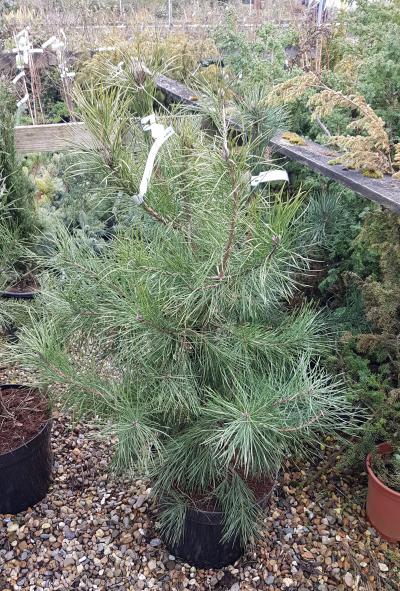
Scots Pine. A tall conical to columnar conifer with blue-green, twisted needle-like leaves. Bushy and vigorous when young, great screening, stately and architectural when old.
Scots Pine. A tall conical to columnar conifer with blue-green, twisted needle-like, leaves. Bushy and vigorous when young, great screening, stately and architectural when old.
Scots Pine. A tall columnar conifer with blue-green, twisted needle-like leaves. Produces green cones ripening brown. Height 8m. Spread 1-3m. Evergreen. Hardy.
This attractive, slow-growing conifer is covered with dense, shaggy, twisted needles. Tolerant of poor, dry sites and coastal conditions. Makes a good accent shrub or border planting. Resembling a small Christmas tree, it is ideal for miniature landscapes.
Scots Pine. A conical to spreading conifer with blue-green, twisted needle-like, leaves. Produces green cones ripening brown. Height 1.8m. Spread 1.5m. Evergreen. Hardy. Planting instructions Back-fill with soil mixed with peat and a suitable fertiliser.
Clusters of long, bluish-green needles on this outstanding broad, pyramidal pine are so delicate even the slightest wind moves them. A witches broom found in Germany on Pinus x schwerinii (a cross between P. strobus and P. wallichiana), the spectacular cultivar produces an abundance of oversized sappy cones. Plants can be pruned to stay beautifully tight and soft; left unpruned, plants become unique informal uprights with pillowy branches.
A new variety of hybrid podocarpus with reddish-green foliage turning deep chocolate in winter.
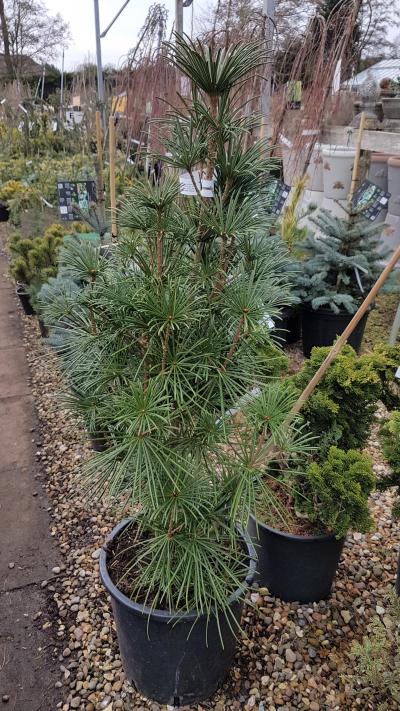
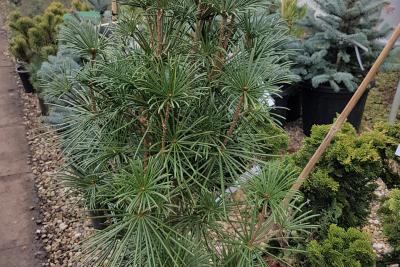
Japanese Umbrella Pine. A conical to columnar tree with red-brown peeling bark. Narrow glossy dark green leaves. Produces cones. Height 10-20m. Spread 6-8m. Evergreen. Hardy.
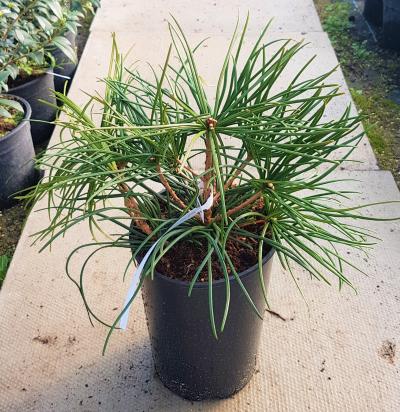
Japanese Umbrella Pine. A conical to columnar tree with red-brown peeling bark. Narrow glossy dark green leaves. Produces cones. Height 10-20m. Spread 6-8m. Evergreen. Hardy.
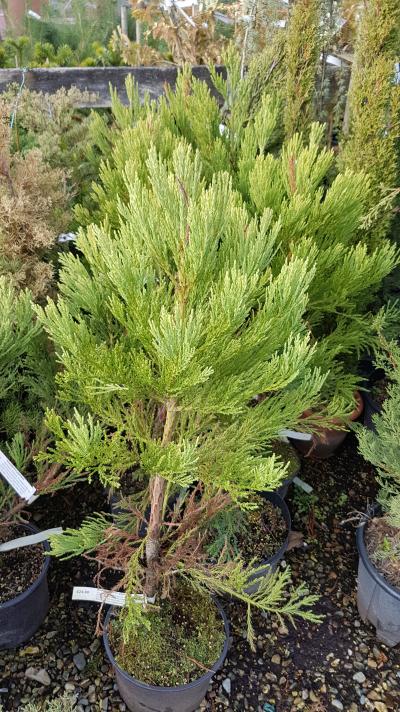
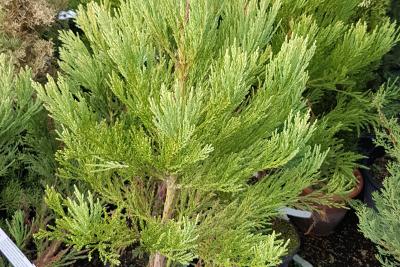
Giant Redwood, Wellingtonia. An evergreen conifer with red-brown bark and grey-green leaves on drooping branches. Produces cones. Height 25-80m. Spread 7-10m. Evergreen. Hardy.
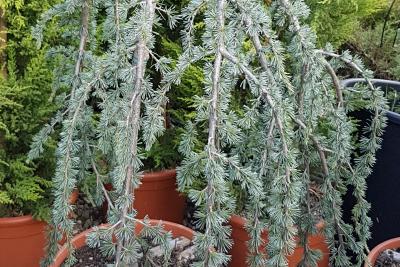
Giant Redwood, Wellingtonia. An evergreen conifer with red-brown bark and blue green leaves on drooping branches. Produces cones. Height 25-80m. Spread 7-10m. Evergreen. A stunning new blue variety, but only for the very large garden.
Swamp Cypress. This is a deciduous conifer that sends out strictly weeping limbs which bear bright green spirally arranged needles. In the landscape, gardeners will stake it to desired height and then allow the developing branches to weep out onto the ground. If it has not been staked when it was first planted it will form a groundcover. During the winter months the limbs will still have interest as the bark exfoliates.
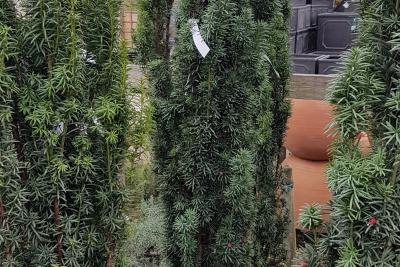
Yew. An evergreen conifer with narrow dark green leaves. Clip to shape. Evergreen. Probably the best evergreen topiary plant. Clip in August. Red berries.
Yew. A broadly conical evergreen conifer with narrow dark green leaves. Evergreen.
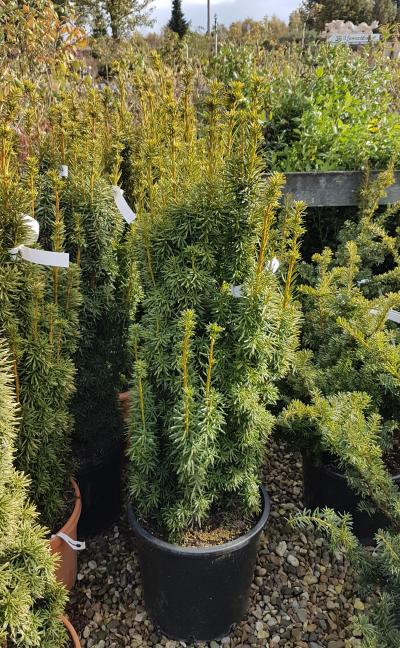
A fantastic new variety of evergreen yew, with gorgeous golden yellow foliage. Forming a narrow upright column upto 4-5ft in 10 years, this slow grower is ideal for long term landscaping projects. Ideal amongst heathers and other low growing evergreens, it's tolerant of dry shade, chalky and acid soils and urban pollution.
Yew. A spreading evergreen conifer with narrow dark green leaves margined with yellow borne on yellow stems. Height 3-5m. Spread 2m. Evergreen. Hardy. CAUTION toxic if eaten.
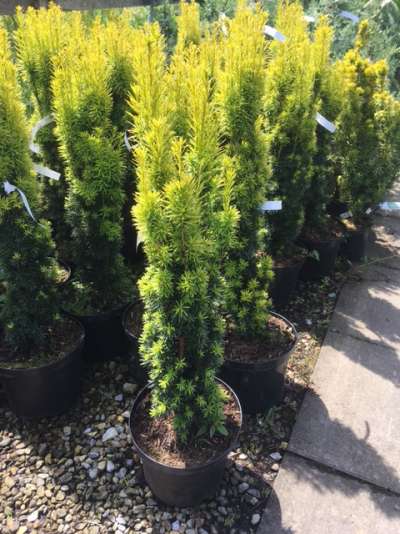
Irish Yew. A narrowly columnar. slow growing evergreen conifer with narrow dark green leaves variegated golden patches. Produces cones. Height 1m. Spread 0.3m. Evergreen. Hardy. CAUTION toxic if eaten.
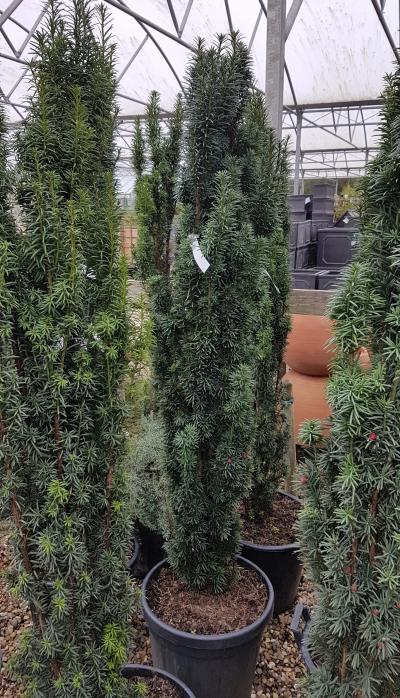
'Fastigiata Robusta' is a coniferous tree that forms a very slow growing, dense, broad column with a multi-pointed crown. It has deep green needles and small red berries in autumn.
A slow-growing, flat-branched, sprawling evergreen conifer to around 3m in height, with bright golden yellow foliage, best in the sun, and red bark. Bright red berries appear in September. A good variety for shaping into a ball.
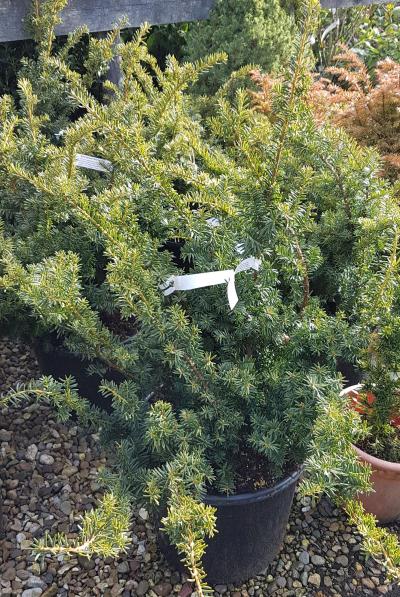
Yew. A low evergreen conifer with broadly spreading branches of yellow leaves in summer becoming green margined with yellow. Produces cones. Height 45-60cm. Spread 1.5m. Evergreen. Hardy CAUTION toxic if eaten.
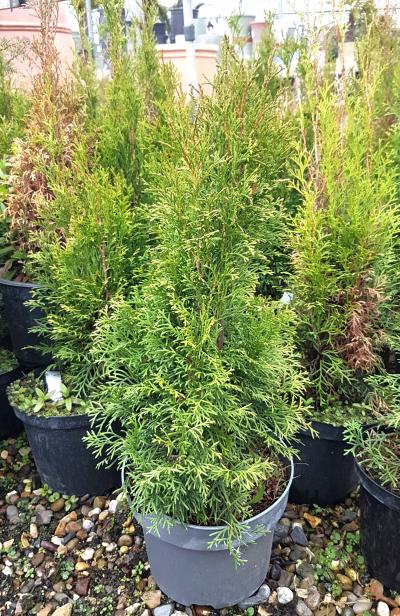
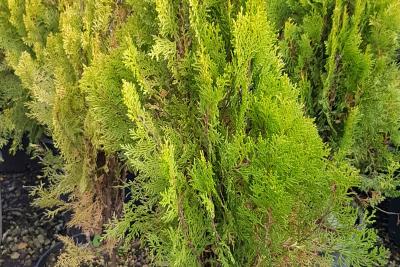
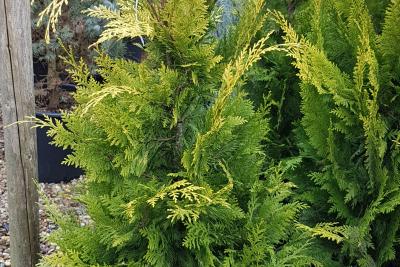
White Cedar. A neat dwarf conical conifer with bright green leaves all through the year. Height 1m. Spread 80cm. Evergreen. Hardy. Harmful if eaten.
Very slow growing. Neat dwarf habit, evergreen foliage. Hardy. Harmful if eaten.
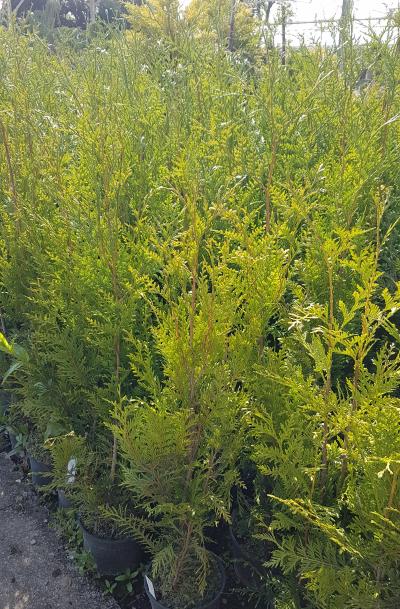
Western Red Cedar. A tall conifer with cinnamon-red bark and aromatic, dark, glossy, green leaves. Height 22-35m. Spread 6-9m. Evergreen. Hardy. Harmful if eaten.
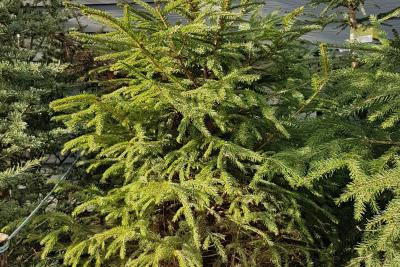
Eastern Hemlock. A mound-forming conifer with overlapping pendent branches of bright green leaves. Height 3m. Spread 5m. Evergreen. Hardy. Shelter from cold drying winds.
Mon - Fri 8:00am - 5:00pm
Sat & Sun 9:00am - 5:00pm

Any questions? Email us or give us a call on 01904 400092.

1.400x267_crop_FFFFFF_autoautoautoauto.jpg)